


The interviews in this series
Gennadiy Fefelov, line producer in Los Angeles
Guillaume Sanjorge, French producer and distributor
Gilles Daniel, screenwriter
Hugo Brisbois, co-founder of Sweetz
Geoffrey D. Calhoun, writer and director
Olumide Gbenro, founder of Ogun Studios
Tommy-Lee Baïk, co-founder of StoryRoads
Margaux Grancher, screenwriter and co-founder of Supradrama
Margot Wilwertz, founder of Vertikals
Illia Berestovskyi, Chief R&D Officer at Holywater Tech: this interview
Holywater produces around 30,000 different video ads a month across its portfolio of apps, including My Drama, its vertical series app. About a thousand a day. In January the company gave 15,000, as I noted in La Dimension Interdite #5, and the pace doubled in the spring. It still holds. Illia Berestovskyi, its head of research and development, explained to me in writing what they are for: when a title does not earn enough, finding out whether the cause is the ad or the story.
Vertical drama, as I have described it since the start of this series, is a serial of 60 to 100 episodes of 1 to 2 minutes (fewer in France, where Margot Wilwertz‘s buyers rather talk of 20 to 40), shot vertically for a phone, whose first episodes are free and whose rest is unlocked with coins. The format comes from China. Estimates of its market range from $8 billion at Deloitte to $42 billion at IntelMarketResearch, depending on what each firm counts. My Drama streams it in more than 35 languages.
Since August, this series of interviews has been working back up the format’s chain, one link per interview: the set in Los Angeles, production and writing in France, the apps, artificial intelligence, brands, broadcasters. With Illia Berestovskyi, the link is the app that buys its audience, title by title.
Who he is, and how this interview was done
Holywater was born in Kyiv in March 2020, with seven people, as I told in April in Bound by Obsession. Its founders, Bogdan Nesvit and Anatolii Kasianov, started with animated iPhone wallpapers, then romance e-books, before moving into video. The company, now Holywater Tech, runs three apps: My Drama for vertical series shot with actors, My Passion for digital books, and My Muse for series produced with the support of generative AI. Together they count more than 100 million users, according to its July 23 release.
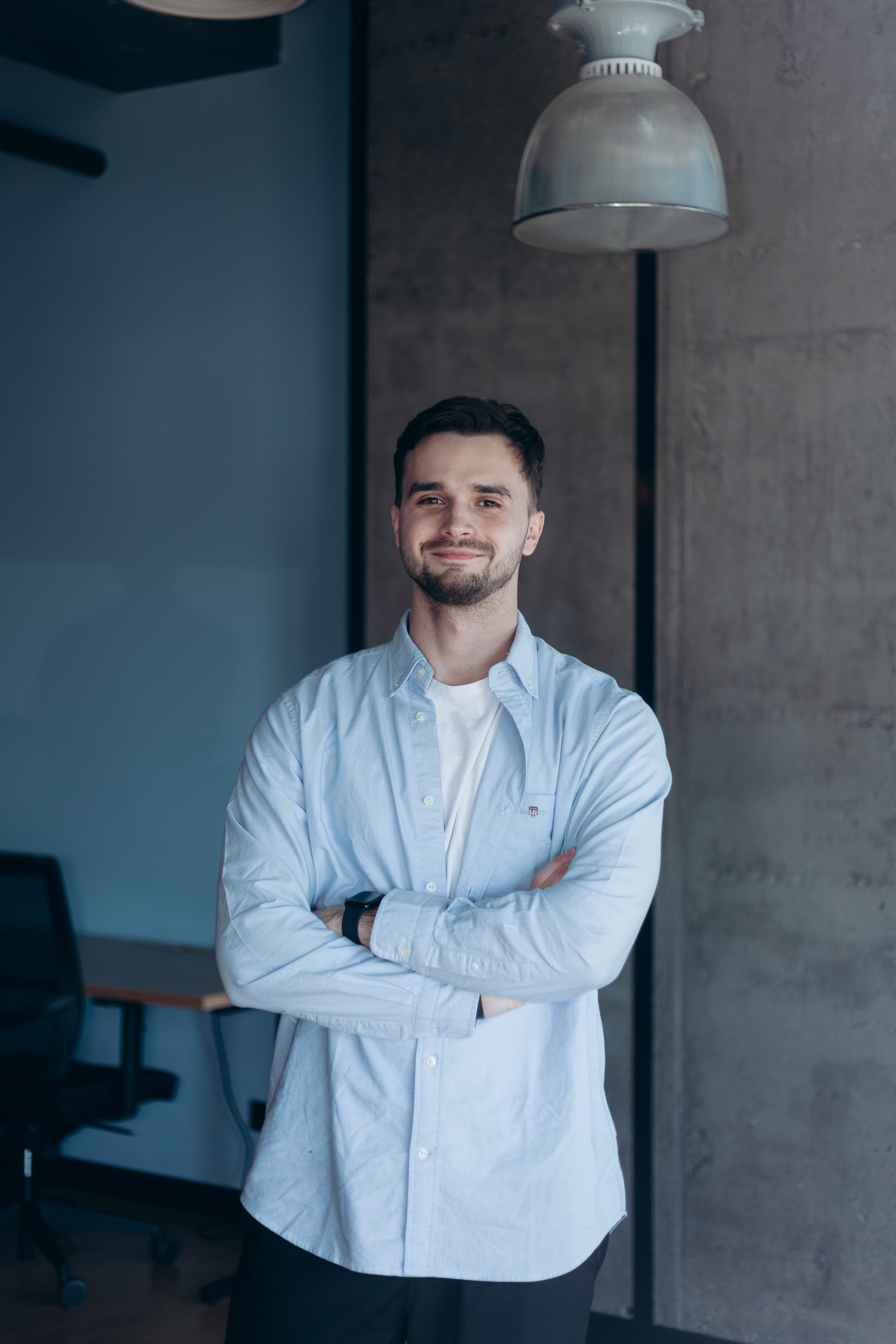
Fox Entertainment, the entertainment arm of the Fox group, took an equity stake in October 2025, without disclosing the amount. In January, Holywater raised $22 million in a round led by Horizon Capital, a Central and Eastern European investment fund. In February, it acquired Jeynix, an AI-assisted visual effects team. It says it is profitable (La Dimension Interdite #5).
Illia Berestovskyi has been its Chief R&D Officer since 2026, after more than ten years in product management and business leadership, during which he managed more than 20 products with a combined audience of over 100 million users. He answered seven questions in writing, in English, then a follow-up question.
“Viewers come for one story”
My questions start from a curve. According to the study “The State of Microdrama 2026”, published in July by Holywater and the consulting firm Owl & Co, the share of men among My Drama’s monthly active users went from 1.1% in the second quarter of 2024 to 30.3% in the first quarter of 2026. Their share grew 28-fold in seven quarters. I quoted it in the interview with Gilles Daniel, next to India, where more than seven viewers in ten are men, then in a September article on known actors who come to the format with genres other than romance.
Men went from 1.1% of My Drama’s monthly active users in Q2 2024 to 30.3% in Q1 2026. What did you change first to reach them?
“From the start, we clearly understood that vertical storytelling could reach a much broader audience than the category initially targeted. It’s fundamentally about how people consume content, and the format can work across genres and audiences.”
“We started with romance because it dominated the category at the time, with clear audience demand for these stories. But we never saw My Drama as a platform limited to one genre or demographic.”
At MIPCOM, the international TV market held in Cannes every October, Anatolii Kasianov put the rest in one line on the main stage on October 14: Holywater raised its male audience to around 30% by expanding into action and thrillers, according to the market’s report.
“As we learned more about our audience, we gradually expanded into new genres, from sci-fi and fantasy to sports-related stories and beyond. This year, including through our partnership with FOX Entertainment, we’ve expanded that range even further. This has helped us attract a broader audience, including more male viewers.”
“We’re building a streaming service with a diverse library, where viewers come for one story and discover others they might not have considered before.”
The study’s survey, run in May with 2,737 users, still puts romance first among the genres watched, at 74%. I asked him which titles brought the men in.
Between Q2 2024 and Q1 2026, which title or genre brought in the most new male viewers on My Drama?
“We’ve seen particularly strong interest from male viewers across several genres, including crime, sports, and LGBTQ+ stories. Mr. Denver, our most-watched series this year, also has one of the largest male audiences on the platform. Meanwhile, titles such as Spark Me Tenderly and Wrestling with Love have been particularly successful in attracting new male viewers to My Drama.”
In the week of October 19, Mr Denver also topped the verticaldrama.tv chart, my site on the format, which tracks some 4,400 series on 55 platforms (the chart gives a rank, without views or revenue).
Werewolves, fencing and a musical
My werewolf question has a history. In July, in Le dernier loup-garou (The last werewolf), I described how pay-per-episode made the billionaire and the werewolf the format’s signature figures, and how one studio, Anamana, was already announcing their end in May. My thesis: the payment model picks the genre, more than the audience does. On My Drama, werewolves kept coming out.
Werewolves keep coming back on My Drama. The latest I found in your new releases is Alpha’s Love Captive. Your report shows men leaning towards sci-fi and fantasy. Which themes are rising on My Drama, which are fading, and has the new audience changed what you commission?
“Werewolf stories and romance continue to perform well, but we’re increasingly exploring genres beyond the traditional vertical series formulas.”
“Echo Protocol, our first sci-fi vertical series developed with FOX Entertainment, is one example. We’ve also expanded into sports-driven stories with Sharper than Blade, an Olympic fencing drama, and experimented with new formats through Playback, a musical featuring 17 original songs.”
The werewolf whose end was announced in May still performs on My Drama, and the library is widening around it. Bogdan Nesvit framed the same choice on Variety’s podcast: stay comfortable, like most Chinese competitors, with 99% of shows in romance, or “push the boundaries” and try other genres.
The next genre is already announced. On October 27, Fox and Endemol Shine North America, which produces the reality show, unveiled a scripted horror series inspired by Fear Factor, 30 three-minute episodes, to premiere on My Drama: the platform’s first horror series, and the first time an unscripted TV franchise becomes fiction.
“These experiments help us understand what resonates with different audiences and use those insights to guide future commissioning decisions.”
“Our goal is to build a diverse content library with strong IP that can grow into longer-running stories, multiple seasons, and potentially other entertainment formats.”
IP, intellectual property, means here a story the company owns and can extend into sequels, seasons, books or films. The library also grows through Fox. Streaming Radar #59 detailed Fox’s deal with creator Dhar Mann’s studio: 40 vertical titles, first exclusive on My Drama, with Dhar Mann keeping ownership. At MIPCOM, Fox did the same with Hartbeat, Kevin Hart’s company: a first slate of 25 live-action titles, thrillers, dramas and faith-based stories, on a channel of its Codeblack label that Holywater is building inside My Drama, the app’s first branded channel, which users can subscribe to on its own. Fox has first look on the film and TV projects that come out of it. “Vertical is where those stories start, not where they stop,” said Jeff Clanagan at Hartbeat.
Day one
When a new title launches, which signal tells your team, in the first days, to keep buying users for it or to stop?
This was the question I was most interested in. An app like My Drama recruits its viewers through advertising, title by title. ROAS, return on ad spend, measures what each dollar spent on ads brings back. Day-one ROAS compares the coin purchases of the first day with the cost of the ads that brought those viewers in.
“Day-one ROAS is the earliest signal we look at, but we assess it alongside projected long-term ROAS, lifetime value, and retention metrics. We want to understand whether a title brings in viewers who stay on the platform and explore other series. Together, these signals help us decide whether acquisition can be sustainable and whether a title is worth scaling.”
Lifetime value is what a viewer brings in over the whole time they stay a subscriber or buyer; retention, the share of those who come back.
“If the economics don’t work, we look at whether the issue is the ad or the story itself. We produce around 30,000 unique video ad creatives every month, so we can test different approaches quickly before drawing conclusions about the content.”
Bogdan Nesvit had described the mechanics in January on the podcast “two & a half gamers”, when Holywater was producing 15,000 a month. Meta’s new Andromeda algorithm gives fewer impressions to similar ads, so Holywater tests different styles and lengths, and makes many ads for each show, which it treats like a mobile game launch. By hand, he said, it would need around 400 motion designers; an internal AI tool makes most of them. The scenes the ads will use are planned at the scriptwriting stage. On payback, he set Holywater apart from ReelShort and DramaBox, which can wait as long as 365 days, “something that companies like us don’t normally do”. The day-one ROAS threshold itself has not been made public.
Paid acquisition is the engine of the model, at Holywater as at its competitors, but the published figures do not measure the same thing. On revenue, Bogdan Nesvit said in the spring that marketing “drives 80% of our revenue”. On users, the notes of an April podcast gave 70% of new users acquired through paid ads against 30% organic (La Dimension Interdite #5). On spend, Media Partners Asia estimates that user acquisition and marketing took 55% of ReelShort’s 2025 revenue. Against production, Timothy Oh, at COL, ReelShort’s shareholder, spends four to five times on marketing what he spends to produce. At MIPCOM, Clare Thompson, of K7 Media, showed a sample business plan, not market prices, in which a large app’s marketing can reach nine times production (Streaming Radar #59).
I had quoted the study figure he gives next in the interview with Hugo Brisbois.
“This reflects a broader evolution in vertical streaming, where long-term engagement is becoming just as important as acquisition. Our State of Microdrama 2026 study with Owl & Co. found that 77% of respondents discover microdramas through paid social ads, while 20% cited in-app browsing (respondents could select multiple answers). We see a significant opportunity to build on that initial discovery by creating a deeper content library and giving viewers more reasons to return and explore new stories.”
In the study, three respondents in four say they discover microdramas through an ad. That is a survey answer; it sits next to the 70% of new users acquired through paid ads quoted above, which comes from another source.
From book to shot series
In July Anatolii said that testing a new genre used to take months and takes weeks on My Muse. Which genre went from a My Muse test to a series shot for My Drama, and what decided it?
Anatolii Kasianov’s sentence is in the July 23 release. Illia Berestovskyi answers with a precise example.
“Our interconnected content ecosystem allows us to develop stories across different formats. My Passion, our digital book platform, helps us identify promising IP, My Muse lets us test those stories through AI-generated video, and My Drama brings them to life as live-action vertical series.”
“One example is the young-adult romance Queen of Hearts. It started as a book on My Passion, was tested as an AI-generated series on My Muse, and the audience response there convinced us to shoot it as a live-action series for My Drama. It is now among the 10 most-watched titles on the platform this year.”
The question was about a genre. The example he gives is a title, a young-adult romance: it shows a story’s path across the three apps rather than a new genre. The order of the three steps follows the spend: the book first, the generated version next, the shoot last. La Dimension Interdite #3 described this circuit in May, generated seasons for a few thousand dollars in two weeks before any shoot. Queen of Hearts gives a named example, from book to top 10. The pool is large: more than 1,000 novels on My Passion for 90 series on My Drama in July, as the interview with Tommy-Lee Baïk recalled.
“This approach allows us to test new genres faster, understand what resonates with audiences, and make more informed decisions before investing in live-action production.”
The study gives two close rates: 23.6% of My Muse users become paying subscribers, against 23.9% on My Drama. The release does not state the period or the population measured; without them, the closeness of the two figures does not show whether a test on My Muse predicts how a shot series will do. At MIPCOM, Dennis Papirowski, TikTok’s global head of content, saw microseries becoming “the litmus test” of whether an IP, a storyline or characters resonate with an audience, according to the market’s report.
Jeynix, or what was not filmed
On the technical side: you bought Jeynix in February for face matching, lip-sync and fast localization. Which video models do you use today (Seedance, Veo, Kling, Runway, others), do you train or fine-tune a model of your own, and have you filed patents on any of it?
“We work with all major AI models, choosing the right tools for each production depending on its creative and technical needs, alongside our proprietary technology and production workflows.”
“A key part of this is Jeynix, our proprietary AI-VFX technology, which we acquired in February 2026. Its capabilities include environment replacement, de-aging, digital makeup, crowd generation, and other visual effects.”
His answer names no model and does not address training or patents; it describes the in-house tool. De-aging gives an actor back the face they had ten or twenty years earlier. The acquisition release also listed facial animation, face replacement and lip-sync. On March 30, Bogdan Nesvit declared a “code red on AI usage” on LinkedIn, the internal alert that calls for moving to AI without waiting, which I told in the interview with Gennadiy Fefelov.
“We primarily use Jeynix for our own series, while also exploring opportunities to work with external studios and production partners. The technology allows us to go beyond the limitations of what was originally filmed, creating scenes that would otherwise require expensive locations, complex production setups, or reshoots. This gives filmmakers greater creative flexibility while making production more efficient. In some cases, AI-powered VFX can reduce production costs by over 20%.”
For scale: on a vertical series at $100,000 or $200,000, the budget Gennadiy Fefelov gave in Los Angeles, 20% would be $20,000 to $40,000. An in-house visual effects team also means a location you do not rent and a day you do not reshoot. On the share of AI, Sasha Tkachenko, head of studio at My Drama, expected at Iberseries in Madrid a split of around 50:50 or 60:40 between generated and shot series: “We’ll get tired and want real faces,” Parrot Analytics reports.
Reality TV in 101 episodes
Farmer Wants a Wife came to My Drama in 101 episodes, about 80 of them free. What did it teach you about reality TV on a vertical app, compared with your scripted series?
Farmer Wants a Wife is a Fox dating show aired in primetime. Its third season was re-edited into 101 episodes of under 2 minutes on average, just under two and a half hours in all, and released in June.
“Farmer Wants a Wife allowed us to explore a different approach to unscripted entertainment. Following our first unscripted series, Love or Dare, we partnered with FOX Entertainment to bring a vertical adaptation of its primetime reality show to My Drama.”
“Unlike scripted vertical series, which are developed specifically for the format, reality TV adaptations work with existing footage. The challenge is to rethink the pacing, framing, and narrative structure rather than simply cutting longer episodes into shorter ones.”
Streaming Radar #54 recalled the 2025 deal between Fox and Holywater, up to 200 vertical series drawn from Fox’s vault, and the same idea elsewhere: the French sitcom Hélène et les Garçons re-cut for the phone, Bravo’s library sent to GammaTime.
“Reality TV already has many elements that work well in vertical storytelling, including strong personalities, relationships, and emotional tension. That’s why we plan to continue investing in and expanding unscripted vertical content on My Drama.”
Europe, and France
Most of my readers are in Europe. Where does Europe stand for My Drama today, and France in particular? When a series travels, do you dub it, subtitle it, or produce in Europe?
“Europe is an important part of our global growth strategy, with European markets already among My Drama’s top five markets. We see strong potential for further growth in the region and plan to continue expanding our presence there.”
“Localization is central to our international strategy, helping stories reach audiences across different markets and languages. Our series are available in more than 35 languages, including French, as France remains an important market for My Drama.”
In France, My Drama shows up first in advertising. In May, Streaming Radar #40 noted, from SocialPeta data, that French is the third language of microdrama apps’ video ads worldwide, at 5.6%, behind English and Spanish, and that Holywater targeted France first on its biggest hit. Poland leads an Eastern Europe where Omdia expects more than 200% growth in 2026, as Streaming Radar #60 cited.
At Iberseries, Sasha Tkachenko gave the scale: a series of at least 55 episodes costs 80,000 to 120,000 in Eastern Europe, currency unstated, with British or American actors brought in if needed, and 120,000 to 250,000 in the United States (Parrot Analytics).
“Looking ahead, we want to continue developing My Drama into a platform where creators, studios, and IP owners from Europe and around the world can share their stories and reach global audiences. Our goal is to give them access to the technology, audience insights, and distribution tools they need to realize their creative potential, regardless of where they’re based.”
The model he describes is the one Fox already applies to Dhar Mann and Kevin Hart: the creator brings the story, My Drama its audience and its tools.
What this interview changes
The earlier interviews in this series mostly put numbers on production. Gennadiy Fefelov gave $100,000 to $200,000 per series in Los Angeles, Margot Wilwertz a target of 150,000 to 200,000 in France. Illia Berestovskyi describes what surrounds the shoot, before and after. Before, a story can go through the book, then through a generated version. After, the series enters an ad workshop, and the return on that spend, from day one, says whether to keep pushing it.
My view: I think the most important number in this interview is the 30,000 ads a month. It says that a vertical drama publisher makes two things at once, series and the means for people to discover them, and that the second is counted in thousands every month.
If you buy audiences for a series app, or make its ads, write to me, off the record if you prefer.
Further reading. Bound by Obsession tells Holywater’s story from Kyiv to Lisbon. La Dimension Interdite #5 follows vertical’s money outside China, acquisition included. The interview with Hugo Brisbois gives the view of a French app, and the one with Olumide Gbenro that of a studio making its series entirely with AI. The verticaldrama.tv newsletter follows the same market, in English.
Ludovic Bostral writes Streaming Radar. He co-founded and ran Afrostream, a streaming service launched in 2015 for African and diaspora audiences, and publishes the Streaming Lens reports on streaming markets. Interview conducted in writing, in English, in October 2026: seven questions, then one follow-up. Photo: HOLYWATER TECH. His answers are reproduced in his own words; the French edition translates them without cuts inside the quotes. The article was submitted to him before publication. Illia Berestovskyi is Chief R&D Officer at Holywater Tech, the Ukrainian company behind My Drama, My Passion and My Muse.