


The interviews in this series
Gennadiy Fefelov, line producer in Los Angeles
Guillaume Sanjorge, French producer and distributor (in French)
Gilles Daniel, screenwriter (in French)
Hugo Brisbois, co-founder of Sweetz (in French)
Geoffrey D. Calhoun, writer and director
Olumide Gbenro, founder of Ogun Studios: this interview
A vertical drama, or microdrama, is a series of 60 to 100 episodes of 1 to 2 minutes, shot upright for a phone: the first episodes are free, the rest are unlocked with coins or paid for by advertising. Omdia forecasts that global microdrama revenue will reach $14 billion by the end of 2026, $3 billion of it outside China, after an estimated $11 billion in 2025. If the format is new to you, my free booklet on vertical drama explains the mechanism, the costs, the rules that just changed in China and what Europe actually produces, with more than 100 references. It is read online with a work email address, and comes as a PDF and an EPUB under certain conditions, set out on the site.
Olumide Gbenro runs Ogun Studios, a studio that makes microdramas generated entirely by AI, with no actors and no shoot. He is also building InterFlicks, an AI microdrama app for diverse audiences. By his account, his biggest clients are production companies that used to shoot, and his studio is one permanent person working with contractors, most of them in Nigeria, Greece, Croatia and Malaysia.
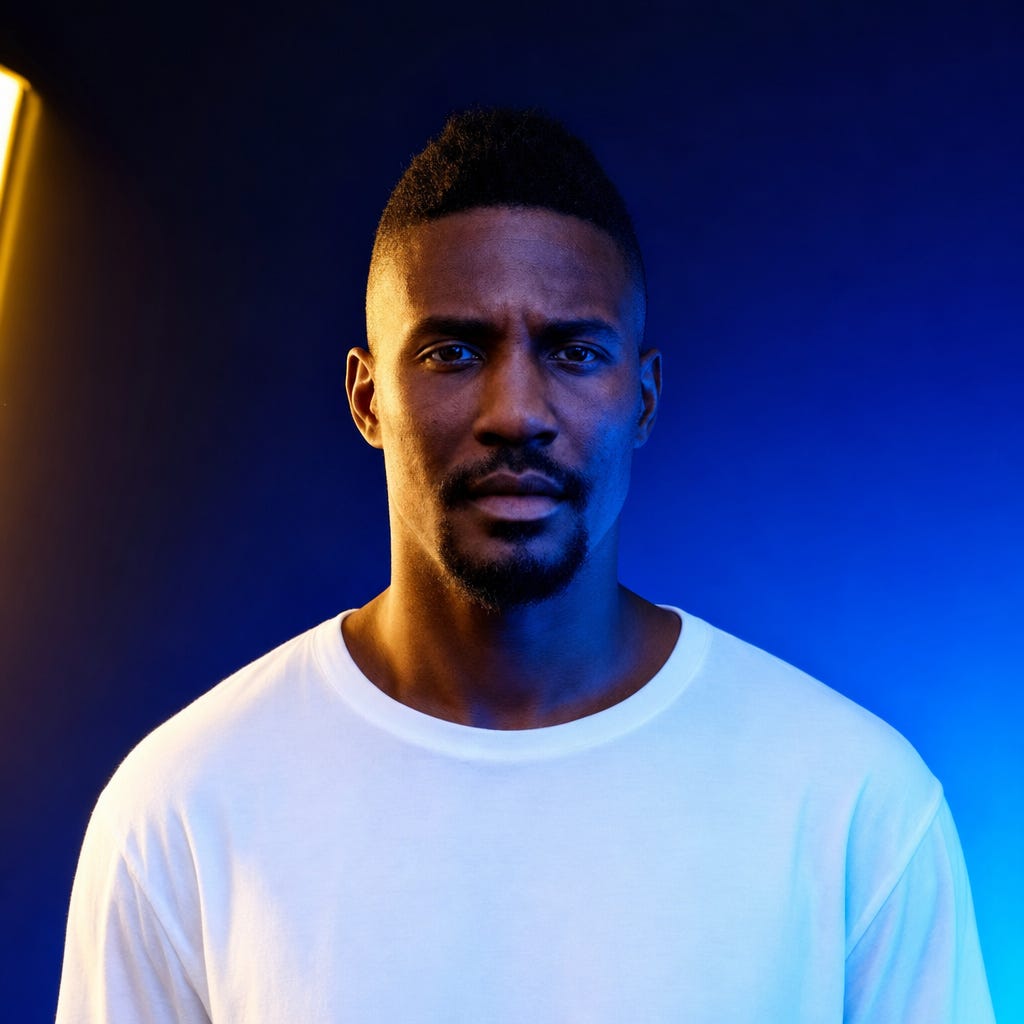
He spent close to ten years in creative strategy for brands, athletes and public figures before moving into fiction. He reports more than 2,000 episodes produced and more than 20 million views, and in August he announced that Ogun had been invited into TikTok’s AI short drama program, which is invite-only. He got in touch on 18 August, answered in writing in three rounds, and agreed to be named.
Ogun is a Yoruba god, and Nigeria has been making low-cost serial film for more than thirty years. I co-founded Afrostream, a streaming service for African and diaspora audiences, and I told him so when I asked about Nigeria: I have a bias, and I would rather declare it. His answer to that question closes this piece.
What Ogun sells, and to whom
The studio describes itself in one sentence.
“Ogun Studios is an AI micro-drama production studio focused on producing the most realistic AI vertical films on the planet. We’re currently engaged with TikTok as well as several of the top short drama app companies in the world. We create full scope verticals and provide a full services offering, from cinematic writing, generative visuals, and platform-native pacing to ship series in a week, not months, and at a fraction of traditional production cost.”
I had asked who the customer was: a brand buying a campaign, a platform buying a series, or a person paying to see themselves on screen.
“As mentioned we have several but primarily micro drama app companies who want realistic dramas but also brands looking to create stories with their IP. We recently started getting requests to place real influencers and notable public personas in dramas. But our biggest clients are traditional productions companies who are now moving into AI for hybrid or fully AI production.”
Hybrid mixes shot scenes with generated ones. On 1 July, announcing Ogun’s move into microdrama, he said where demand was: “The biggest demand is in fantasy, historical, or folklore related titles. Because let’s face it, why spend millions to create something you can spend six figures on.” In the same post he said he planned to integrate real actors and go hybrid “real soon”.
On what the TikTok agreement gives him, he keeps the contract private.
“I can’t speak on our contract as it’s private but what I can say is we get access to distribution by being able to create for diverse audiences on their platform and they place it where audiences are most likely to discover. ByteDance is a wonderful partner and have connected us with many resources for production as well as team members to help us any moment we need.”
ByteDance owns TikTok and makes Seedance, the video model Ogun uses. Three things are on record about the partnership: his August announcement that Ogun had been invited into TikTok’s AI short drama program; one title that his site lists as produced for TikTok, Bound to the Glass Prince, 50 episodes with the same generated cast throughout; and the answer above. The contract terms are not public.
I also asked him to look two years out: will AI microdrama be a category of its own, or simply how all microdrama gets made, and what happens then to a studio whose positioning is the AI part? He answers that microdramas are “a category of their own”. The second half of the question stayed unanswered in writing. Since our exchange, he has begun building InterFlicks, an app that could make him a publisher as well as a producer. Its catalogue lists upcoming titles, among them Married to a Secret Jamaican Billionaire, produced by Ogun Studios.
How an episode gets made
He had published a template, built over a year, that turns a pasted episode script into scenes, frames and blocking shots. He had graded it himself a C minus: the blocking was off and the AI acting was not there yet.
“We fixed this recently! Our C minus is now an A- (thanks to the release of Seedance 2.5 and it’s adherence) simply because of a structure we use to instruct the model where everything is in a scene so it knows how characters move around the objects. Before the models didn’t adhere to instructions even when stated verbatim but now it’s no longer a problem.”
The grade is his own. Seedance 2.5 came out on 31 July 2026, four weeks before his answer, and ByteDance gives it single generations of up to 30 seconds. On 1 August he described what that changes for him: “We used to generate 5-6 videos at a time to stitch. Now we are likely only going to need 2, 3 max.”
In the same answer he named what the model does not replace.
“The secret behind our production is indeed a director that has live action experience to make sure we cover every issue that someone without a decade of experience would see. Small things matter so we account for that along with our strong AI production side.”
Compute costs and client pricing
I gave him two reference points. Vigloo, a Korean platform, released a 22-episode AI series in March, made in 8 weeks by fewer than 10 people, for $33,000 according to the creator Benjamin Pott, quoted in the Fefelov interview. And Fefelov’s own shot season.
“Regarding episode cost, it ranges but typically we’re spending minimum $100 per minute to get a perfect output (including regenerations). The Vigloo numbers are pretty close and it’s not 10 people for us it’s 3. We’ve built agents that we can converse with and co-produce every scene of every episode with, it’s quite remarkable.”
A regeneration is a fresh request to the model when a shot does not work. When reviewing this article, Gbenro clarified that the roughly $100 per minute refers to compute costs, not what Ogun charges clients. Client pricing is closer to $1,000 per minute, he says, including labour, pre-production, editing, script writing or conversion, final production and dubbing. He has not provided a breakdown of the studio’s total costs.
He had described the mechanism on 8 August, commenting on a calculation by another creator, Sirio Berati: “In traditional live action, actors get paid the same the whole day, a ‘day rate.’ So if you stay over time and do 100 takes of the same scene, there’s no increased cost.” And further on: “With AI there’s no set cost, if we want to get a ‘perfect’ scene it might take us 48 tries at $10.” On 1 September he wrote that he had spent over $8,000 of his own money working out his process.
Set next to the other interviews, each figure covers something different. Calhoun’s $10,000 for 21 finished episodes, about $317 a finished minute, was cash out with post-production included, and left out his 6 months of unpaid preparation. Fefelov’s $100,000 to $200,000 for 60 episodes, $833 to $3,333 a minute depending on episode length, stops at the rushes, the raw footage from the shoot. Vigloo published no budget of its own.
Ogun’s roughly $1,000 per minute is a selling price for the full service, whereas the Calhoun and Fefelov figures describe production expenditure with different scopes. They cannot be compared as equivalent production costs.
For scale, a hypothetical 60-episode season at a minute and a half per episode runs 90 minutes. Applying Gbenro’s approximate per-minute figures gives about $9,000 in compute costs and about $90,000 in client pricing for the full service. These are arithmetic extrapolations, not a quote for a commissioned season. The difference does not establish Ogun’s margin: labour and the other costs of delivering the service have not been itemised.
Likeness, remakes and the AI label
His offer includes placing real people into fiction as digital doubles, something he did before microdrama. In 2024 he founded Creatoor AI, a video generator built on personalised avatars. In March, Ad World News still described Ogun Studios as an AI ad agency, and he described a typical ad there: a lawyer client’s digital twin cast as a superhero, ending with a call to action for their real law office. I asked how consent is handled, what the contract covers, and what happens to a likeness once a campaign is over.
“We don’t deal deep into this but we get a contract for rights to use the IP and for how long. But we’re still early on with this. Most of our first notable people are friends that are excited to participate in this exciting new economy and trust we will respect and care for this IP respectfully.”
The answer covers the rights of use and their duration. It does not say what happens to a likeness after a campaign, or whether a twin can be reused. I also asked whether a paying client constrains the plot.
“There are no constraints, in-fact we have an open field to do almost anything. The biggest thing AI did was open up VFX and unique genres that would cost way too much (and be risky) to produce at scale. What I’ll say about what we have refused is content that doesn’t align with our values or the cultural depictions that aren’t accurate or respectful. We use this to educate potential clients and in many cases have made corrections to ‘save’ the project.”
He has also published AI remakes of famous commercials and of the first episodes of well-known microdramas, labelled as experiments, and he had publicly asked where the line was. I put his own question back to him: if any title can be regenerated in an afternoon, what is left of IP, and what protects his own work?
“Well there’s lots of IP left, I don’t own the IP of what I posted and I made sure that was labeled and explained in the post. I mainly made those to get on the radar of production companies in my target industries and it worked. I think as the industry catches up to AI and starts legally owning their own likeness, there will be less malicious copycats or people chasing viral imitation content ( I won’t use the word slop here haha). All in all people need to stop complaining and hire an attorney, make your supposedly valuable IP valuable. I know it sounds harsh but truth is.. if you’re not in the place to protect your work like this then it’s clearly not that valuable.”
Under one of those remakes, on 18 July, he explained that Ogun was “developing our own exclusive slate of 40 AI micro-dramas” and shopping them to major vertical studios.
In August he wrote on LinkedIn that the only way viewers know his series are AI is because he tags them as AI. I asked whether the tag changes performance.
“Tags make no difference from what we are seeing. People just want to be transported to a world of adventure, romance, or impossible scenarios they can immerse themselves in, whether for 1 episode or 100. We haven’t seen any penalty, in-fact as long as the story is good from limited data we see 20% higher performance in the AI version.”
The 20% is his figure, from limited data, and he does not say what the AI version is compared against. It says nothing on its own about the effect of the label.
Nollywood and the diaspora
My question on Nigeria was the most direct one in the set. Nollywood is one of the largest film industries in the world by volume, with exactly the low-cost serial production culture this format rewards. Why isn’t AI microdrama coming out of Lagos, and is Ogun more than a name?
“Ogun Studios is named after a god in the Yoruba religion, Yoruba being the ethnic group I was born into so we are very intentional that we create IP that will serve the diaspora (it’s just not being posted yet) but we have over 20 titles in some way related to Nigeria and Africa (either through the characters, ex: immigrant Nigerian lead character in New Orleans) or even with regard to our current slate, there’s already Nigerian influence... some of our writers are young talented Nigerian creators (so when you see a minor character named ‘Ade’ don’t be surprised haha). So although it may seem we aren’t focusing on this right now, it is in our roots.”
“But one important note is that also Nollywood is almost like traditional Hollywood. As I mentioned, some of the most talented creators I’m seeing out of Africa are creating from their computers and working with western clients just like myself rather than live action with real cameras that Nollywood does. And there are huge hits coming out of Nigeria already, people may not be aware of like because algorithms may not serve to a worldwide audience yet.”
The hit he linked to is Billion Naira Bride, 60 episodes produced by the Nigerian studio DCAA and released on TikTok by the US publisher LunarTicks. The series crossed 70 million views in less than 30 days, according to its screenwriter Blessing Azugama on 6 September.
“And a final nuance.. as with Afrobeat music, the real is global but tends to be localized to where the largest African populations are located (Houston, Texas, New York, New York, London, UK).”
YouTube gives a related figure. In a statement relayed by the Nigerian press in May 2025, it said that in 2024 more than 70% of the watch time of Nigerian YouTube channels came from viewers outside Nigeria. The figure covers all Nigerian channels, not only Nollywood, and viewers abroad are not all diaspora. YouTube did not name the markets.
Where the work goes
I asked him whether geography still means anything when a piece of fiction needs no set, no crew and no country.
“I’m a one man team with LOTS of contractors. The advantage is no matter the time zone someone is always awake and working. Yes costs are much lower as I find talented young creatives in developing countries. But this isn’t about exploitation, we pay very well. […] This is life changing income for a young person in places like Nigeria, Greece, Croatia, Malaysia where most of my teammates are based.”
On 10 September, The Hollywood Reporter documented lost work in Los Angeles with examples. A talent manager went from 15 to 20 vertical shows casting a day to about 4 after June. A production designer and director who made one series a month for a platform lost the contract in July, when the platform went fully AI. Ogun sits on the supply side of the same shift, and I asked whether his demand jumped in those weeks. He answered with a case.
“First off I don’t want to be the blame of people losing jobs. My biggest insider perspective is that I work with one producer out of LA who used to work full live action production and has had some hit shows, now they work with me to produce our AI shows from some of the top micro-drama apps. People who are ‘losing jobs’ is one-sided. The smart producers will realize that AI and hybrid (mix of live action and AI) is the future and the faster they learn how to transfer the skills the better. And in my experience it pays more, rather than be on set all day you can work on 2-3 productions at a time and definitely make more money (you lose the cost of gas to commute, food etc that you burns a hole in your pockets)”
The earlier interviews in this series pointed one way: AI lowered the price of the image more than the price of the text, as the Calhoun interview summed it up. Gbenro’s account fits that on his own terms. His offer starts with “cinematic writing”, some of his writers are Nigerian, and he names a live-action director as the secret of his production. His site says: “Every season we produce is written and directed by people; the pipeline replaces the camera, the cast, and the location, not the taste.”
The Hollywood Reporter’s examples show work lost in Los Angeles. Gbenro describes work organised differently in his own case: a live-action producer turned AI producer, contractors in Nigeria, Greece, Croatia and Malaysia, and production companies turned into clients. None of this measures the balance of jobs across the sector.
The Nollywood answer is the part I learned most from. When I asked the question, my hypothesis was that AI microdrama would come out of Lagos studios, because they know how to shoot fast and cheap. Gbenro describes another route: African creators working from their computers for Western clients, himself among those clients. One interview does not show which route will carry more of the market.
To go further. The guide to the format and its market covers the format, and the business model follows where the money moves. What a vertical season costs elsewhere gives the range, from $12,000 in China to $300,000 for a US studio. China’s micro-series factory crosses the border follows the chain back to its origin (in French). The five earlier interviews are listed at the top of this article.
Ludovic Bostral writes Streaming Radar. He co-founded and ran Afrostream, a streaming service launched in 2015 for African and diaspora audiences, and publishes the Streaming Lens reports on streaming markets. Interview conducted in writing between 18 August and 12 September 2026, in English: three rounds of questions, three rounds of answers. The article was submitted to him before publication. His answers are quoted in his own words and spelling, with one exception, “in come” written as “income”; cuts inside a quote are marked […]. A French version is available, with the same quotations translated. Olumide Gbenro is the founder of Ogun Studios, an AI microdrama production studio, and is building InterFlicks, a microdrama app.
Photo supplied by Olumide Gbenro.