


Last week I rebuilt Afrostream in five hours. It’s live at afrostreamia.vercel.app.
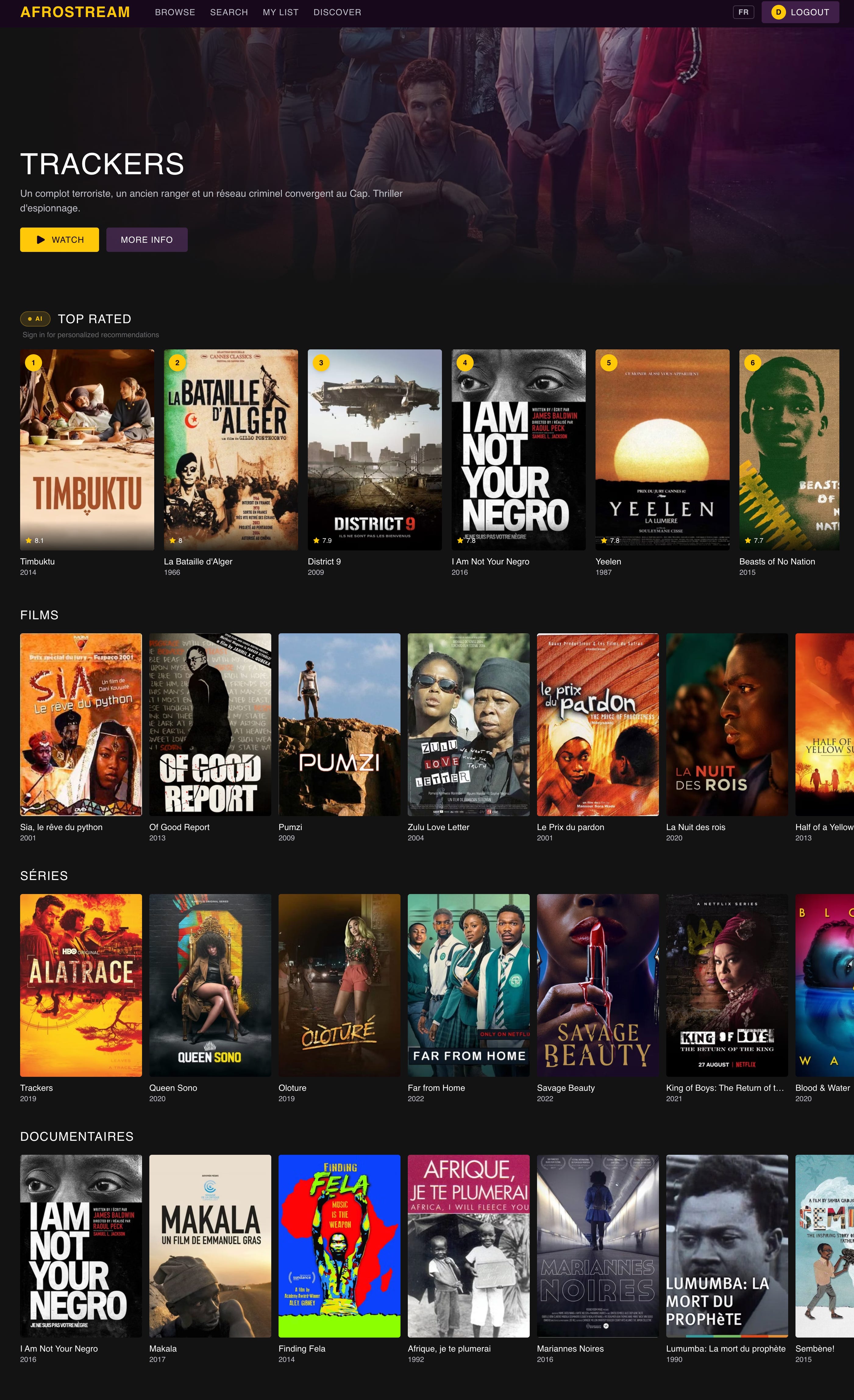
Yeah. That needs context.
I’ve spent 25 years building video pipelines. Wiring FFmpeg into internal pipelines to generate HLS, fighting piracy, tricking Apple. At M6 Replay, where I worked for seven years, my CTO was emailing with the guy who created HLS and I was adding HLS with the help of FFmpeg because no tool could handle it.
When I built Afrostream a few years later, the encoding problem was the same but with a DRM layer on top, because we were negotiating with Warner, Sony, Disney. We worked with Unified Streaming to stream contents. We found this company in the Netherlands, built originally for RTL. For years it was one of the most important products in video distribution worldwide and almost nobody outside the industry knew it existed. I worked with them directly, which meant I spent a lot of time in Amsterdam. Half my trips there were to visit Unified, the other half were for IBC, the big trade show for OTT and professional video. People always assume you go to Amsterdam for the freely accessible cannabis and the coffee shops. I don’t drink coffee, I don’t do drugs. I drink too much Coca-Cola.
Today, producing HLS is a commodity. You pick a tool, you transcode, you’re done. Keep that in mind.
The first time
Afrostream was a streaming platform for African and African-American content. Think Netflix, but focused. Tonjé Bakang founded it, I joined as cofounder and CTO. We got into Y Combinator in 2015.
At our first office hours (weekly one-on-ones where YC partners tell you what you’re doing wrong), Michael Seibel looked at us and said: you need to show traction. So we thought OK, let’s put up a website and run a crowdfunding campaign. All we had at the time was 80,000 followers on a Facebook page. Yes, Facebook. It was 2015.
We launched the page with a launch date of September 1st. We were still in a hacker house in Mountain View at this point. I remember the exact moment we got our first customer because I was in the bathroom. I’d had a burrito. I heard Tonjé calling my name, pure joy in his voice. Our first sale. 2,500 people ended up pre-buying a subscription at €40 each. That’s €100,000 in pre-sales. We had no platform, no catalog, and not a single line of code. We’d built a demo page we called “Best in Black” and somehow YC thought it was the actual product. We never corrected them. It was a page.
So there we were. €100,000 in pre-sales, $150K from YC incorporation. We had a Letter of Intent with Sony (basically a piece of paper that says “we’ll talk about it later”). We needed investors. We needed an actual streaming platform. And we’d told 2,500 people it would be ready on September 1st.
I moved into a house in Mountain View with two developers I’d just hired. One of them was Benjamin, who I’d first worked with at M6 Web and kept dragging along to every company since. The other was John, an American developer. We had three months. I handled the video encoding pipeline, they handled the website. We lived together, coded together, ate together. There were these excellent burritos that had the added benefit of regulating our digestive systems. Translation: we spent a non-trivial amount of time in the bathroom after lunch.
By August, we had a working streaming platform. A real one, with a catalog, a player, authentication, payments, the whole thing. On September 1st, we launched with somewhere between 500 and 800 hours of content, $1.5 million raised (two of our investors were French, and the fact that they signed checks in August in France still feels like a minor miracle), offices in Nantes, two employees, and on my end, three consecutive sleepless nights handling customer support. We made it. Barely.
That codebase is still sitting on GitHub. Open source. github.com/afrostream. Twenty-one repos, six programming languages (JS, Go, PHP, Python, HTML, LESS), running on Heroku and Docker, with RabbitMQ handling the messaging, and over sixty database tables. In 2015, we were all-in on microservices because Netflix was doing microservices and we were already copying Netflix for everything else, so we might as well go full tribute act with a fraction of the talent.
Here’s a thought that keeps nagging me: is agentic AI just microservices wearing a trench coat? You have small, specialized units (agents) communicating through protocols (MCP), each handling one piece of the puzzle, orchestrated by something that’s supposed to keep them in line. Sounds familiar. We just replaced RabbitMQ with natural language. I’m not sure that’s an upgrade.
The second time
I’ve been deep into Claude Code for a few months now. Built a CRM with it (I didn’t know what a CRM was, but that’s another story). Built an MCP server for my newsletter (50 tools at the time, 80 now). Made a podcast where I don’t talk in it. Tried (and spectacularly failed) to produce an AI-generated video trailer from my novel.
Then Jonas Birmé broke my brain. Jonas is VP R&D at Eyevinn Technology and the guy behind their Open Source Cloud, which is basically managed open-source video infrastructure you can spin up without dealing with any of the plumbing yourself. He’d just posted about building a streaming service in 36 hours with six AI agents, zero lines written by him. And my brain did the thing it does, which is: wait, I have the old Afrostream code, I have Claude Code, I have Jonas’s open-source tools, what if I just... tried?
So I tried.
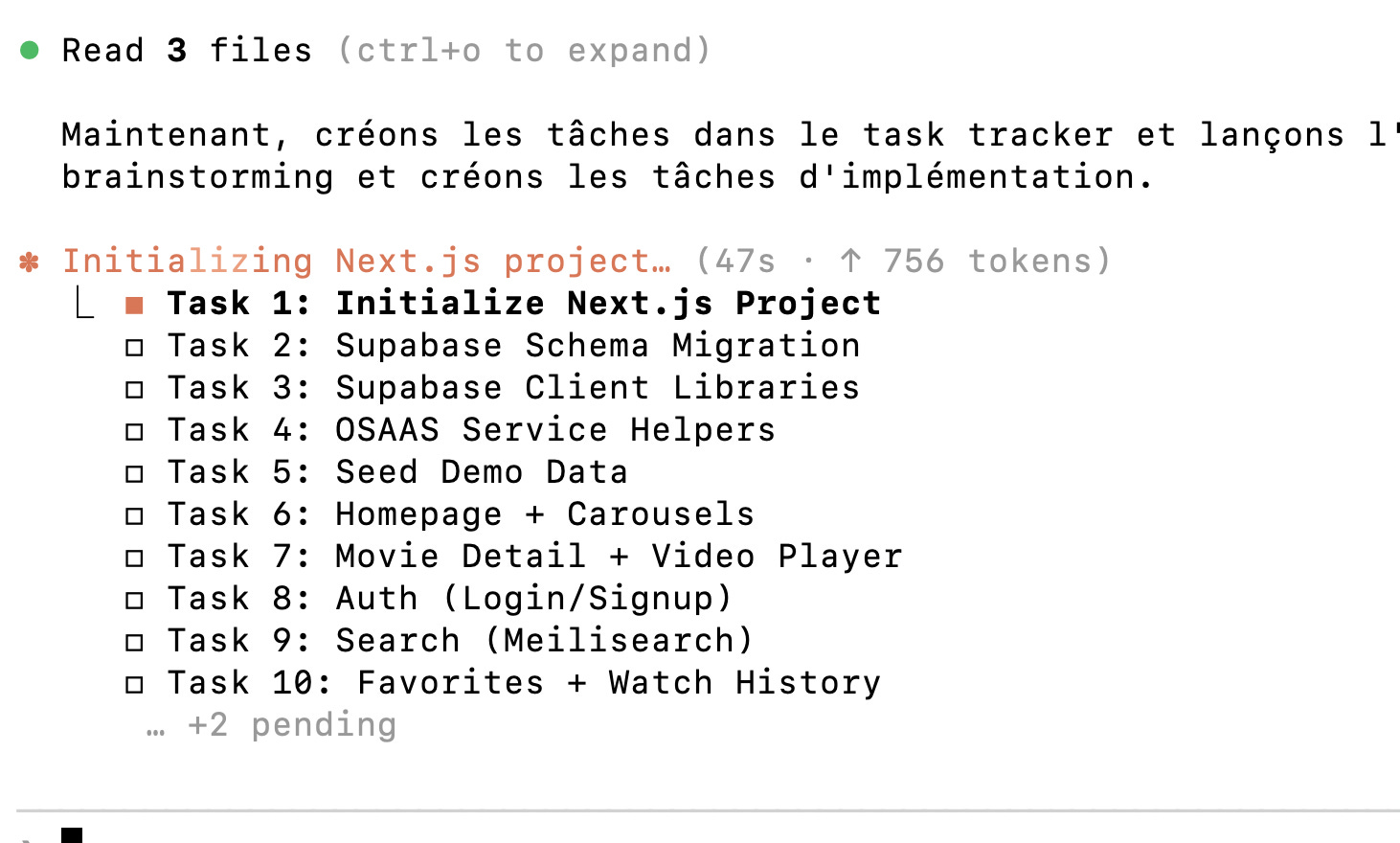
I didn’t use Claude Code alone, though. I used it with the Superpowers plugin. I gave it the old Afrostream GitHub repo, hit the brainstorming option, and it started asking me questions about the plan.
The actual bottleneck wasn’t code. It was retrieving API keys and putting €10 into OpenAI (the king of negative ROI). I spent more time on authentication paperwork than on building the platform. Then I got stuck trying to find the right poster image for Timbuktu. You know what Timbuktu means: a place that is very far away. The image certainly was.
Fun coincidence: it pulled in The Movie Database (TMDB) for the catalog data. The same TMDB that Benjamin had used years ago to build “Best in Black.”
Then Claude produced a design. It was terrible. Generic, flat, the kind of thing that says “I am a default template and I have no opinions.” So I forced it to use the original Afrostream color scheme: purple and gold. That palette was designed by the former head of art direction at M6 Web, and it’s one of the few things from the original Afrostream that still holds up.
Once the core was working, I decided to add things we never had in 2015. A chatbot that helps you pick a film by asking what mood you’re in. Back in the day, we used Intercom for customer support. This chatbot is considerably more relaxing than answering “why can’t I watch this in Belgium” at midnight.
Then came the video problem. I couldn’t pirate the Warner and Sony catalogs (also I genuinely don’t know how torrents work). So I did what every developer does: Big Buck Bunny, our industry’s favorite open-source rabbit. Growing up in France, the only rabbit I knew was the one getting its fingers stuck in the metro doors. Different vibe.
Remember those twenty-one repos and sixty tables?
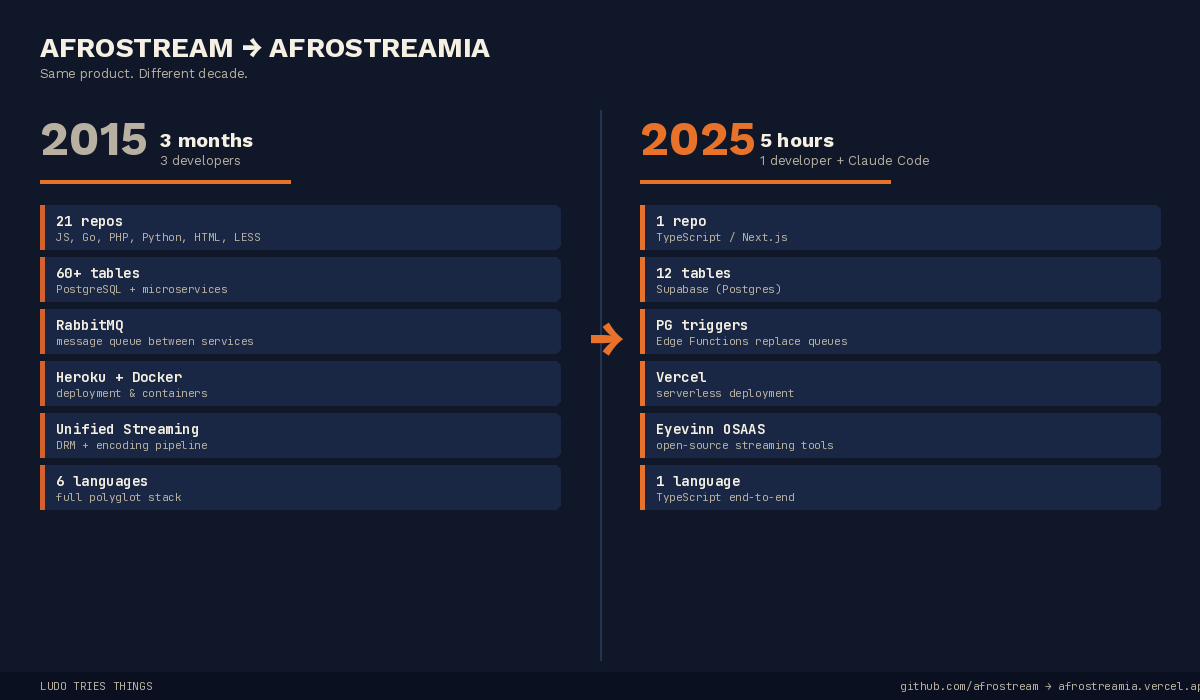
Twelve database tables instead of sixty. PG triggers and Edge Functions instead of RabbitMQ. One language instead of six. I feel like I should apologize to someone, but I’m not sure who.
Everything users actually touch is done. Browse, search, play, save to your list, admin panel. The part that took us an entire summer in that house where the burritos were excellent and the bathroom was occupied. Three months with a team versus five hours solo. Even if you add two weeks to make this production-ready (payments, proper encoding, edge cases, testing), that’s still a compression factor that makes the 2015 version feel like it was built with stone tools. If you want a hot take about what that means for the industry, LinkedIn is right there, plenty of people will oblige.
The entire stack is open source. In 2015 the ecosystem wasn’t mature enough to build a full platform on it. Now it is.
The weird feeling
Rebuilding your own startup is weird. Afrostream was real. We raised money, moved to California, got into Y Combinator, launched, had actual paying users. And now it’s a side project I can spin up in an afternoon.
I keep thinking about that Mountain View house. What two developers spent a summer building, I just did between lunch and dinner. Benjamin, I still work with. M6 Web, Afrostream, then Majelan, Kessel, Trace. I keep hiring him. He gets it. He was in that house. And all those years I spent understanding video encoding, from hacking HLS into FFmpeg in an M6 office to tricking Apple’s app review with fake audio-only tracks to debugging DRM tokens at 2am for Afrostream? The new version replaces all of that with two open-source tools and a config file. The knowledge is still useful (I know why things break), but the manual labor part evaporated. Nobody asked me. It just did.
It will call M6 Replay “MC Streetplay” and you won’t notice until someone points it out. It will write a blog post roasting a developer for not validating a PR (that happened). You’ll ask it to save a source for later and it will produce a full 2,000-word Streaming Radar article, unsolicited, with an editorial line you never approved, and it’ll be weirdly good.
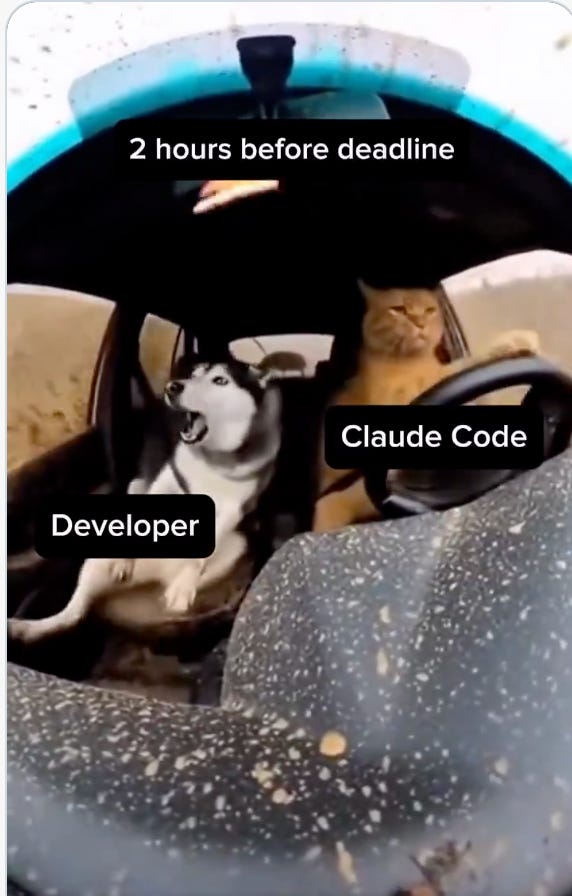
I don’t have a dog. I’ve always preferred cats. I wrote a whole novel about one. Anyway.
Here’s the thing: the five hours aren’t impressive because of the AI. They’re impressive because they prove the technical work wasn’t the hard part. We just thought it was because it took so long.
To be fair, I didn’t start from nothing. I had the old Afrostream codebase to feed Claude. I had Jonas’s Open Source Cloud doing the heavy lifting on video infrastructure. I had ten years of video encoding becoming a commodity. Experience made me faster, not because I wrote better code, but because I knew what to skip and what to steal from my own past.
Everybody in tech right now is doing the “experience still matters” dance. It’s not wrong. It’s just incomplete. The experience that matters isn’t the technical kind. If I can rebuild Afrostream in five hours, someone with five years of video experience could probably do it in eight. The technical gap between expert and competent just collapsed.
What didn’t collapse: knowing that 80,000 Facebook followers could turn into €100,000 in pre-sales. Tonjé’s conviction that the audience existed. Two French investors signing checks in August. Three months in a house where you learn what your cofounders are actually made of. None of that was code.
And none of it gets you to a real product, because what actually makes a streaming service work isn’t the pipeline. It’s the quality of the experience, the recommendation engine, and whether your catalog fits the people you’re trying to reach. That’s where the game is now. The plumbing is solved.
I wrote about this six months ago. I thought it was a theory. Turns out it was a prediction.
This is Ludo Tries Things. Half experiments, half curiosity, zero guru energy. For streaming industry analysis, Streaming Radar is over here.