


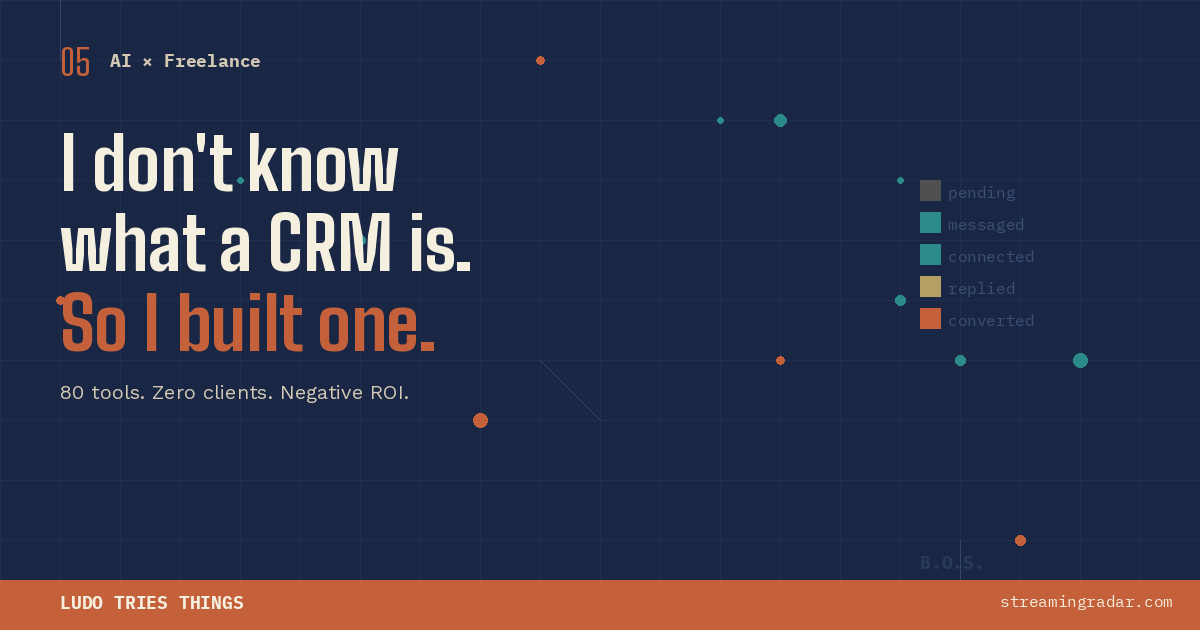
Last week, my MCP server had 50 tools. Today it has 80. I need to stop. I won’t, but I need to.
(If you don’t know what an MCP server is, I wrote about it a few issues ago. Short version: it’s a way to give AI tools access to your stuff. My stuff being two research databases, a newsletter archive, and now apparently the emotional state of my sales pipeline.)
So here’s the thing. I recently went freelance again. You know the drill. The LinkedIn post where you announce your “new chapter” with a sunrise emoji. I didn’t write that post. I thought about it for four seconds and closed the tab.
But the problem remains: you need clients. And clients don’t just appear because you updated your headline. Clients appear because you talk to people. You follow up. You send that slightly awkward email where you’re trying to sound casual but you’re actually sweating.
My mother asks me every year what I do. The only time she stopped asking was when I worked at M6 Web, between 2007 and 2013. She thought I worked in television. M6 was the second biggest channel in France at the time. I never corrected her. It was the only job title she could explain to her friends, and honestly, I wasn’t going to take that away from her. Point is: if my own mother can’t figure out what I sell, imagine a stranger on LinkedIn.
So you’d think the solution is to just talk to more people. Go outside. Network. But I don’t have a dog. This is relevant because a dog gives you an excuse to go outside and accidentally bump into humans. My building doesn’t allow dogs (or maybe it does, I’ve never actually checked, which tells you everything about my level of social initiative). So the dog strategy is out. What I have is a LinkedIn export and a strong opinion about CRM software.
CRM stands for Customer Relationship Management, which sounds like something from a McKinsey deck right between “synergy matrix” and “stakeholder alignment.” I just want to know who I talked to and whether they seemed interested. That’s it.
So I tried existing tools. Folk, Attio, HubSpot free tier, a Google Sheet with color-coded rows. I even tried one of those LinkedIn automation tools. Took me about a day to realize it was slower than what I’d already built myself. Never even made it past the free trial. That’s two potential sponsorships I’ve killed in two articles.
Every tool wants to be your entire business operating system. I don’t have a business operating system. I have a text file with names in it and a vague sense of guilt about not following up.
So I built one. In my MCP server. Two days.
Here’s what it actually looks like. Six lists: consultants I know, streaming decision-makers, Africa report prospects, US/Canada contacts, Europe, and a general pipeline. Each contact has a status, a priority, and a field I’m particularly proud of called “angle_perso” which is basically “why would this specific human care about what I do.” Notes update as conversations happen. The whole thing runs on Supabase, same database as Streaming Radar.
My workflow now: I open Claude. “Show me my warm leads.” I get a list. I pick someone. “Draft a follow-up for Marie, mention the streaming audit we discussed.” Claude writes the email, I tweak two words (because Claude is still slightly too polite and I am not), and I send it. Without opening Gmail. Without opening a CRM. Without opening anything except the conversation I was already in.
Is this a good CRM? Absolutely not. No pipeline visualization. No forecasting. No calendar integration. But here’s what it has: I actually use it. That’s the whole point. I never went back to Folk. I never opened the Google Sheet again. But I talk to Claude every day anyway, so the CRM is just... there. Like a Post-it note that talks back.
Now, the part where I spent 10 euros. I built a Chrome extension (took about an hour, Claude Code again) that lets me tag profiles on LinkedIn and send the data straight to my MCP server. Haiku processes each one for about 0.001 euros. I’ve tagged ten people so far.
At this rate, I have enough credits to last until Christmas 2027.
But “having a pipeline” is apparently step one of being a functioning freelancer, according to every podcast hosted by someone who sells courses about freelancing.
(I just heard the neighbor’s dog barking. That dog gets invited to more aperos in this building than I do. I have 80 MCP tools and the dog is winning.)
The truth is, I’ve sent my CV four times in my life. Twice in 2000, twice in 2007. Since then, never. People call me. I go. I do the job (good or bad). Then they call me again. For 25 years, that worked. Y Combinator, streaming startups, tech companies. Always the same pattern: someone needs a thing done, someone mentions my name, my phone rings.
But here’s what I realized recently. They called me because I’m a good tool. Not because I’m a good thinker. And there’s a difference. A tool gets hired to execute. A thinker gets hired to decide. I’ve been the tool for two decades and now I want to be something else, and I’m 49, and nobody is going to rebrand me except me.
So I built a CRM. Not because I’m good at sales. Because I’m bad at it, and I needed something that would fit inside the one tool I already open every day.
Now scroll back up. I said “I don’t have a business operating system.” That was twelve paragraphs ago. Since then I’ve described a database, six contact lists, an email integration, a Chrome extension, and 80 MCP tools connected to everything.
A Business Operating System. B.O.S.
My name is Bostral. My handle is ludobos. I’ve been building a BOS without even noticing.
Eighty tools. Zero guru energy. Negative ROI. Subscribe for more.
This is Ludo Tries Things. Half experiments, half curiosity, zero guru energy.
Ludo Tries Things is the experimental side of what I do. For streaming industry analysis, Streaming Radar is over here → www.streaming-radar.com